

CNBSF (Irreversible GST Inhibitor)
Product#: FNK-FDV-0031
$418.60
Availability:
Ships in 1-2 Weeks
CNBSF (Irreversible GST Inhibitor)
Cat.No. FNK-FDV-0031
Size 10mg
Storage -20 ºC
Formulation C6H3ClFNO4S
CAS No. 3829-23-0
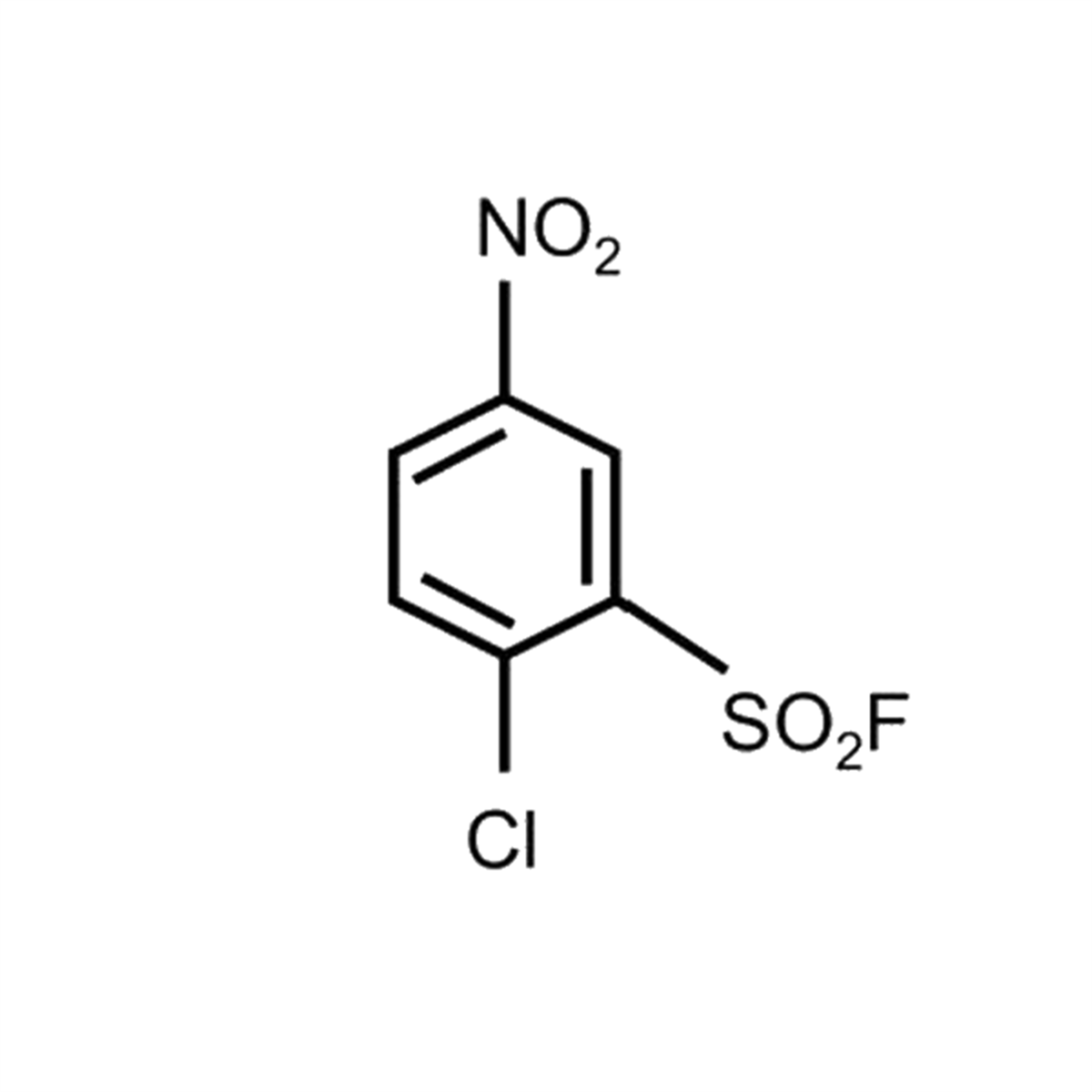
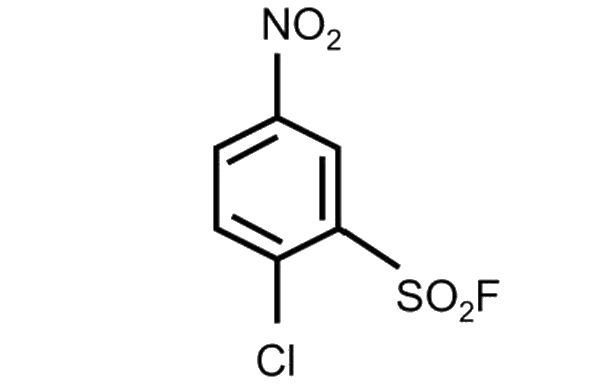
Chemical structure See Figure 3
Molecular weight 239.6 g/mol
Solubility Soluble in DMSO
Description
Glutathione S-Transferases (GSTs) are widely conserved in nature from bacteria to plants and animals. In human, over 20 members are identified and classified into three subfamilies cytosolic including seven classes alpha, mu, omega, pi, theta and zeta, mitochondrial and membrane-bound microsomal members. GSTs plays an important roles in detoxification of endogenous toxic metabolism or xenobiotics through converting them to glutathione (GSH)- conjugates.
Generally GSTs have two types of binding site, called G-site and H-site, for GSH and hydrophobic substrate, respectively. When GSTs bind to GSH, GSTs catalyze and stabilize thiolate anion of GSH. Once hydrophobic substrates binds to GSTs, GSTs transfer them to GSH to form GST-conjugates. GST-conjugates are quickly exported to extracellular space by multidrug resistance-associated protein (MRP) transporters. Through the above processes, GSTs detoxify toxic compounds. On the other hand, GSTs also neutralize pharmaceutical drugs via its detoxifying processes.
Generally GSTs have two types of binding site, called G-site and H-site, for GSH and hydrophobic substrate, respectively. When GSTs bind to GSH, GSTs catalyze and stabilize thiolate anion of GSH. Once hydrophobic substrates binds to GSTs, GSTs transfer them to GSH to form GST-conjugates. GST-conjugates are quickly exported to extracellular space by multidrug resistance-associated protein (MRP) transporters. Through the above processes, GSTs detoxify toxic compounds. On the other hand, GSTs also neutralize pharmaceutical drugs via its detoxifying processes.
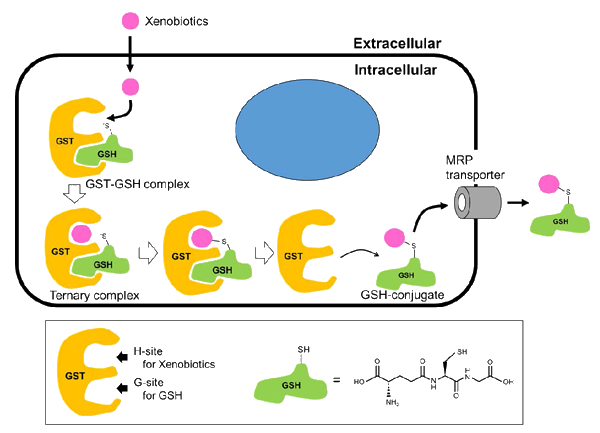
Figure 1. Detoxification process of GSTs
As many studies suggested expression level of GSTs are significantly increased in cancer cells, GSTs are considered as anticancer-resistant enzymes in cancer cells. Inhibition of GST activities is one of the promising strategy to improve drug efficiency in cancer cells. Some GST inhibitors have been developed so far, however, conventional inhibitors including ethacryic acid (EA), a representative GST inhibitor, were based on the competition with GSH. In general, competitive inhibitors are usually reversible and not sufficient in cells because of high concentration around mM order of GSH in cells.
Although several irreversible inhibitors were also discovered and show potent inhibition in vitro, these compounds have low membrane-permeability and are not good at live cell experiments. To overcome conventional problems, highly membrane-permeable and irreversible inhibitors are desired.
2-chloro-5-nitrobenzensulfonyl fluoride (CNBSF) is a novel type of irreversible GST inhibitor reported by Dr. Hiroshi Abe, Nagoya University, and co-workers (Ref.1). CNBSF is membrane-permeability and capable of entering into cytosol. Once CNBSF incorporated into cell, GSTs catch CNBSF in H-site as a hydrophobic xenobiotics. Subsequently GSTs convert CNBSF to GSH-conjugated CNBSF, called GS-5NBSF. In the case of GSTP1, a member of pi-type GST, Tyr108 residue in GSTP1 quickly reacts with sulfonyl fluoride group of GS5NBSF, fluoride anion was leaved, and form covalent bound between GST and substrate. In the result of above scheme, GSTs covalently bound inhibitor-complex are inactivated.
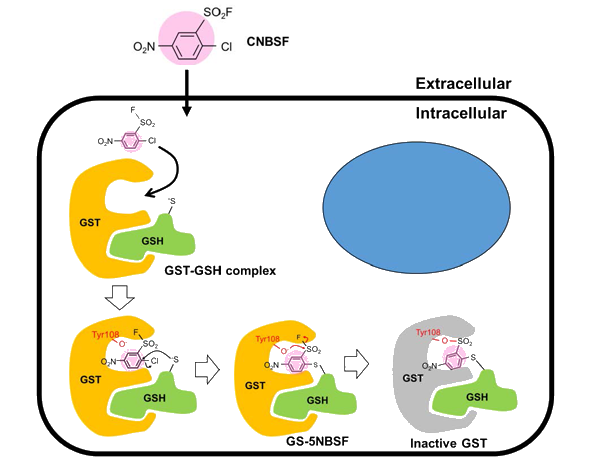
Figure 2. Inhibition mechanism of CNBSF
Reconstitution and Storage
Reconstitution : stock solution in 100% DMSO.
Storage (solution): Store powder at -20oC.
After reconstitution in DMSO, aliquot and store at -20 °C. Avoid repeated freeze-thaw cycles.
Storage (solution): Store powder at -20oC.
After reconstitution in DMSO, aliquot and store at -20 °C. Avoid repeated freeze-thaw cycles.
Recommended concentration
For cell-based experiments : >1 mM
For in vitro experiments : 0.1-1 mM
For in vitro experiments : 0.1-1 mM
* For both cases, the concentration should be optimized by yourself.

Recently Viewed
Fluorescent NIR Dyes
$0.00
Vinylsulfone-PEG4B-COOH
$437.06
Alpha-Glucosyl-GNP
$89.54
Hymeglusin, 5 mg
$475.59
D-Talitol, ≧99%
$346.79
Streptochlorin, 5mg
$792.62

ELISA Microplate Washer (BK-9622)
$2790.00